A Boomi AtomSphere CI/CD practice is built on one idea: package an integration process once as a versioned artifact, then promote that single artifact through Dev, Test, Staging, and Production by calling the Boomi Platform API instead of clicking through the AtomSphere UI. The mechanics are not the hard part; the hard part is governing them so a bad packaged component never reaches a production runtime that a QAD master-data sync depends on, and so every promotion leaves an audit trail an automotive quality system can examine. Within Digitus's Boomi AtomSphere integration series, this guide covers the deployment-governance dimension, and a companion piece in the same series treats AtomSphere authentication and security, so this one stays on promotion, versioning, and recovery rather than credential design. It is written for integration architects, ERP and iPaaS owners, and platform engineers at US manufacturers who run Boomi alongside an ERP such as QAD Adaptive ERP, where a September 2025 Forrester Total Economic Impact study commissioned by Boomi found that the platform's interface and pre-built connectors reduced integration development time by 65%, moving delivery from weeks to days (Forrester / Boomi, 2025).
What You'll Learn
How API-driven AtomSphere deployment differs from manual UI promotion, and the two Platform API operations that do the work
How to govern environment promotion with Environment Extensions and production version pinning across Dev, Test, Staging, and Prod
How to version and release packaged components so every production version maps back to an exact source state
The UI-only rollback constraint, verbatim from Boomi's documentation, and the staging-redeploy pattern that engineers around it
How the POST /AuditLog/query endpoint plus pipeline run logs supply documented-information evidence under IATF 16949 Rules 6th Edition
A packaged component is the unit of release in Boomi, and CI/CD is what moves that unit through environments without a human clicking Deploy. Per Boomi's deployment documentation, deployment "is the process of preparing processes and components to run in test or production environments" and runs in two distinct steps: packaging, which creates a point-in-time snapshot, then deployment, which assigns that snapshot to one or more environments (Boomi Deployment docs). API-driven CI/CD automates both steps by calling the Boomi Platform API, so the same snapshot lands in every environment identically and every action is logged.
What makes the packaged component a sound artifact for a pipeline is its self-containment. Boomi's documentation states that "a packaged component contains the primary component and all the dependent components that are required to support that component (such as subprocesses, connectors, or maps)" (Boomi Packaged components docs). A single package therefore pins an entire dependency closure. Promote it and you promote the process and everything it needs as one traceable bundle, which is the precondition for reasoning precisely about what changed between two releases.
In practice a Boomi pipeline performs two operations against the Platform API: a CREATE on the PackagedComponent object to package a process, taking a Component ID and returning a Package ID, and a CREATE on the DeployedPackage object to deploy that package to an environment, taking the Package ID plus an Environment ID. The community often calls these createPackage and deployPackage, but those are convenient shorthand, not formal Boomi SOAP API operation names; the Platform API exposes generic CRUD verbs applied to those objects. We walk through this exact sequence, Retrieve Process Details, Fetch Component Details, Create Packaged Component, Deploy Component, in Digitus's Boomi CI/CD implementation guide, using the AtomSphere API Connector and Dynamic Process Properties to pass the Env ID and Package ID between pipeline stages.
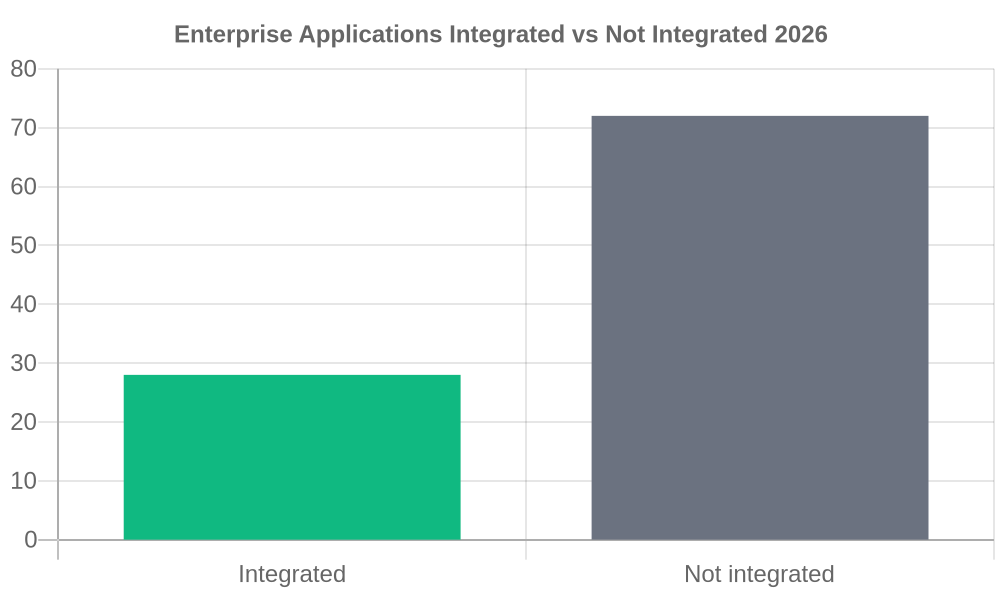
The case for automating this is scale. Integrate.io's 2026 enterprise integration statistics report that only 28% of enterprise applications are integrated even though organizations run roughly 897 applications on average (Integrate.io, 2026). Treat that figure as a vendor-aggregated estimate rather than primary research, but the direction is unambiguous: every integration is a deployment surface, the number a manufacturer runs only grows, and manual promotion cannot scale across that surface without drift, mistakes, and audit gaps.
How does API-driven deployment differ from manual UI promotion?
The difference is governance, not the artifact, because both paths produce the same packaged component. A manual flow has an engineer log into AtomSphere, package a process, and click Deploy once per environment, which means no enforced quality gate, an audit record that lives in screenshots and memory, and consistency that depends entirely on human discipline. An API-driven pipeline replaces those clicks with version-controlled steps that run identically every time, write a log for every action, and refuse to promote until automated checks pass.
The cost of the manual path is operational, and for a manufacturer it is not abstract. We saw it framed plainly in our own delivery: when Boomi brokers a master-data sync between QAD Adaptive ERP and a group's Oracle EBS, a deployment that quietly diverges between Test and Production does not surface as a developer inconvenience, it surfaces as a supply-chain planning gap and a financial-reporting mismatch at the same time. Velocity without governance simply lets a team ship that mistake faster, which is why the two have to be engineered together rather than sequenced.
The table below contrasts the two approaches across the dimensions a manufacturing integration team actually weighs. The point is not that manual deployment never works; it is that it stops scaling the moment a team runs more than a handful of integrations across more than two environments.
Dimension
Manual UI deployment
API-driven CI/CD
Promotion mechanism
Click Deploy per environment
One versioned artifact promoted via Platform API
Quality gate
None enforced
Automated checks gate each stage
Audit trail
Screenshots and recollection
Pipeline run logs in Git plus AuditLog API
Multi-environment consistency
Depends on operator discipline
Environment Extensions parameterize per environment
Recovery
Manual UI rollback only
UI rollback plus pre-deployed staging target
Scales to many integrations
Poorly
By design
Why does environment promotion governance matter for manufacturers?
Environment promotion governance is the difference between a Boomi change being a routine release and being a production incident that halts a plant. For a manufacturer running an ERP, the integration layer is load-bearing infrastructure, and the stakes are highest exactly where Boomi sits between systems of record. We learned this on a greenfield implementation for an automotive and EV sub-assembly manufacturer, where we stood up QAD Adaptive ERP 2023 with Boomi carrying real-time data exchange between QAD and the group's Oracle EBS platform, alongside barcode-driven material movements and PLC-based production reporting, in a four-month go-live (Digitus digitalized-operations case). In that topology a misconfigured packaged component reaching production does not break one screen; it breaks the data contract that operational ERP and corporate financial consolidation both rely on.
The mechanism that makes promotion safe is Environment Extensions: parameterizing connections, credentials, and process properties per environment so the same packaged component points at the correct database, endpoint, or queue without hardcoding. Its production counterpart is process version pinning, holding production on a known deployed version so in-progress development work never propagates unintentionally. Together they let one artifact move across four environments while behaving correctly in each, which is the entire promise of promotion and the precondition for the master-data parity that an ERP integration demands. The same discipline underwrites our broader QAD integration using Boomi work, where master data flows from Oracle EBS into QAD AERP 2023 and transactional data reverse-syncs.
Boomi's deployment model also gives promotion a zero-downtime property that matters when a process is mid-transaction. Boomi's documentation states that "when you deploy a new version of a process to an environment, the new version replaces the previous version currently running on the associated runtimes. Any in-progress executions will complete with the previous version but future executions will use the new version" (Boomi Deployment docs). A promotion therefore does not drop a just-in-time call-off or a shipment confirmation that is already executing, which is a guarantee a manufacturer cannot afford to lose during a release.
A governed topology reflects these stakes. A common and defensible shape is a Dev Atom and a Test Atom for development and integration testing, then a Staging Molecule and a Production Molecule for pre-production verification and live operation, where an Atom is a single-node runtime and a Molecule is a clustered runtime built for high availability. Each stage records its Env ID, its Environment Extension set, and its rollback path, so any promotion is fully reconstructable after the fact.
How do you version and release packaged components in Boomi?
Versioning is what turns a Boomi deployment into a release a team can reason about, and Boomi makes the version a durable property of the artifact itself. The version ID is a user-defined alphanumeric identifier such as "1.0" or "Alpha Release", and Boomi auto-increments it from the previous version if you do not supply one. Critically, Boomi's documentation states that "the version ID that you specify uniquely identifies version of the packaged component and stays with the version no matter where it is deployed or shared" (Boomi Packaged components docs). One package therefore moves across Dev, Test, Staging, and Production as a single identifiable thing, which is the foundation of release management on the platform.
A disciplined versioning scheme pairs naturally with a Git branching model: feature branches for work in progress, a develop branch producing packages for the lower environments, and a main branch representing production-ready state. Because a packaged component carries its whole dependency closure, a version pins the process plus every subprocess, connector, and map it needs, so promoting a known-good bundle is unambiguous. Release management then adds the procedural layer on top, change windows, approval gates, deployment notes, and a documented rollback target for every promotion.
The reference table below maps each CI/CD activity to the Boomi Platform API object it touches, so engineers building automation know exactly what each step operates on and which privilege it requires. The naming follows Boomi's SOAP API object model rather than community shorthand.
CI/CD activity
Boomi Platform API object
Operation
Required privilege
Package a component
PackagedComponent
CREATE, input Component ID
Packaged Component Management plus Build R/W
Deploy to an environment
DeployedPackage
CREATE, input Package ID plus Env ID
Deployment access
Query or manage a runtime
Atom
GET / QUERY / UPDATE
API access plus ATOM_MANAGEMENT
Retrieve audit events
AuditLog
POST /AuditLog/query
API access
Roll back a deployment
UI only, no API object
Manual UI procedure
Deployment access
The runtime-management half of that table is confirmed by Boomi's Atom object documentation, which supports GET, QUERY, CREATE, UPDATE, and DELETE, with UPDATE limited to four fields including name and purgeHistoryDays (range 0 to 9999, default 30) (Boomi Atom object docs). A pipeline can therefore check whether a runtime is online before deploying and tune history retention per environment as infrastructure-as-code, though it cannot create a local runtime programmatically; CREATE only attaches runtimes to cloud instances.
What are the best CI/CD tool-integration patterns for Boomi?
Any CI/CD system that can authenticate and make Platform API calls can drive a Boomi pipeline, because the deployment interface is the API, not a vendor-specific plugin. The four common choices are GitHub Actions, Jenkins, Azure DevOps, and GitLab CI, and most teams begin with GitHub Actions. Digitus's Boomi CI/CD implementation guide is a working reference for that starting point: a GitHub repository named after the Boomi process, environment-specific Feature, Dev, Test, and Prod branches, and branch-triggered deployments that drive the AtomSphere API Connector through the four-step package-then-deploy sequence, with Dynamic Process Properties carrying the Env ID and Package ID between branches. Rather than re-explain that published sequence, this guide extends the pattern to the other toolchains and to the quality gate.
Jenkins is the common choice where a team wants a self-hosted server and an explicit pre-deploy quality gate. A public Jenkins-Boomi reference implementation wires SonarQube static analysis ahead of the Boomi API deployment, orchestrates Jenkins and SonarQube with Docker Compose, and authenticates using the Boomi token format BOOMI_TOKEN.user@company.com:bOomi-aPi-ToKen (CHEREF-Mehdi Jenkins-Boomi reference). Its pipeline stages, artifact preparation, SonarQube scan, Boomi API deployment, and report publishing, make the quality gate a hard prerequisite: if the scan fails, the deployment step never runs.
Azure DevOps and GitLab CI follow the same logic with different plumbing. A two-pipeline pattern works well in Azure DevOps: a Build pipeline performs the PackagedComponent CREATE and stores the Package ID and component IDs in the repository as configuration-as-code, and a Release pipeline performs the DeployedPackage CREATE across environments. GitLab CI needs no special connector at all, because any GitLab job that can issue authenticated API calls can package and deploy. The determining factor across all four is API access and credential handling, not a plugin, which is where this article's companion piece in our AtomSphere series on authentication and security best practices becomes the natural next read.
Toolchain
Trigger model
Native quality gate
Best fit
GitHub Actions
Branch push or merge
Via workflow test steps
Teams already on GitHub; Digitus reference implementation available
Jenkins
Job or SCM poll
SonarQube plugin
Self-hosted estates wanting a strict pre-deploy code-quality gate
Azure DevOps
Build plus Release pipelines
Pipeline tasks
Microsoft-centric estates; config-as-code IDs in the repo
GitLab CI
.gitlab-ci.yml stages
Job-defined steps
Teams standardized on GitLab; pure REST-driven
How do you handle rollback and release recovery in Boomi?
Rollback is where Boomi CI/CD automation hits a hard wall, and a team must design around it deliberately rather than discover it during an incident. Boomi's official documentation describes rollback as a UI-only procedure performed through the Deploy menu, with no documented Platform API endpoint, so a team that has fully automated packaging and deployment still cannot trigger recovery the same programmatic way. The flow is manual end to end: from the Deploy menu select Deployments, clear the date filter, locate the component, use the Actions icon to select Rollback, choose a previous version, optionally add notes, review, and deploy (Boomi rollback docs).
The constraint is sharper than UI-only, and it is the detail that quietly breaks naive recovery plans. Boomi's documentation states verbatim that "only versions that have been previously deployed to this environment are available for selection." You cannot roll a production environment back to an arbitrary version; you can roll it back only to a version that was already deployed to that exact environment earlier. A package that exists in your account but was never deployed to production is not a valid rollback target there, which means recovery depends on what your promotion process put into the environment's history before the incident, not on what is theoretically available.
The workaround follows directly from the constraint: make sure the rollback target is always pre-deployed. Promote every release through Staging before Production and keep the prior known-good version in each environment's deployment history, so a rollback becomes a re-selection of an already-deployed version rather than a fresh, unplanned deployment under pressure. Where faster recovery is needed, the practical equivalent of a rollback is a forward staged redeploy, re-promoting the previously validated packaged component from Staging into Production through the same pipeline, which satisfies Boomi's "previously deployed" requirement while running through your governed, logged path.
For our managed Boomi engagements this is delivery practice, not theory. Because we run the same packaged component through Staging before Production as standard, the prior version is always sitting in the Production deployment history, so recovery is a rehearsed re-selection rather than a scramble. The discipline that protects the forward path, promote one artifact, gate each stage, keep history, is the same discipline that makes the backward path survivable.
How does Boomi CI/CD support IATF 16949 audit evidence?
For automotive and EV manufacturers, deployment governance is where DevOps practice meets quality-management compliance, because a change to an integration that feeds a quality system is a controlled change. IATF 16949 is the automotive quality-management standard, and its clause 7.5.1.1 documented-information requirements mean changes affecting product quality must be controlled and evidenced. The IATF Rules 6th Edition, published in 2024 and in force from 1 January 2025, did not rewrite those underlying requirements; it tightened how certification bodies plan and conduct the audits that verify them (IATF Global Oversight). The practical effect is more scrutiny on change control, so when a Boomi process governs a master-data sync or a shipment flow that feeds a quality system, the record of how and when it changed becomes audit-relevant.
Boomi's Platform API supplies that evidence trail. The audit endpoint is POST /AuditLog/query, on base path /api/rest/v1/{accountID}/, with filters on type, action, and modifier fields, returning timestamped records of platform events such as who changed what and when (Boomi governance and audit insights). Paired with CI/CD pipeline run logs held in Git, the result is a machine-generated deployment history that replaces the screenshots-and-recollection approach manual workflows leave behind. A pipeline that records the packaged-component version, its target Env ID, the approver, and the confirming audit entry produces exactly the chain of custody an auditor expects for documented information.
This is where our manufacturing focus is more than a vertical label. Our QAD and Boomi integration for manufacturing work sits inside automotive supply chains where this evidence is examined rather than hypothetical, and where a deployment change log is part of the documented information a quality system maintains. One scoping caveat belongs in any honest treatment: the AuditLog endpoint exposes platform audit events and is not itself a quality-management system, so its evidentiary value depends on how the record is governed and retained. The useful point for an integration team is that Boomi already generates the raw material an IATF auditor wants; the work is wiring it into the pipeline and retaining it under change control.
What results can a mature Boomi CI/CD practice deliver, and how does Digitus approach it?
A mature Boomi CI/CD practice changes four things at once: how fast a team can deploy, how often a deployment fails, how quickly it recovers, and how defensibly it can prove what changed. The Forrester TEI study commissioned by Boomi quantifies the velocity side at the platform level, a 65% reduction in integration development time and, for the composite organization, 347% ROI over three years (Forrester / Boomi, 2025). Those are platform-wide figures rather than CI/CD-specific ones, but the mechanisms a pipeline installs, automation, gating, version control, and rehearsed recovery, are exactly what turn that velocity into releases a manufacturer can trust, because for a manufacturer an ERP integration is both performance-critical and audit-relevant at the same time.
We approach Boomi CI/CD as ERP-integration risk management, because that is what it is when Boomi sits between an ERP and the systems a plant runs on, and the combination that shapes our practice is unusual: deep QAD Adaptive ERP delivery paired with hands-on Boomi work, so a deployment decision is judged by its supply-chain consequence, not its DevOps elegance. The clearest proof is in production. On a greenfield automotive and EV sub-assembly manufacturer we implemented QAD Adaptive ERP 2023 with Boomi integrating QAD to Oracle EBS and across ERP and MES, with barcode-based material tracking, PLC-driven production reporting, and MMOG/LE alignment, in a four-month go-live (Digitus digitalized-operations case). There the value of disciplined deployment was measured in shipments that moved and books that reconciled, not in a dashboard, and a bad packaged component would have been a supply-chain event rather than a developer inconvenience.
Our Boomi CI/CD implementation guide is the working reference behind this practice, showing the AtomSphere API Connector driving the package-then-deploy sequence inside a GitHub Actions pipeline; this guide extends it to multi-tool pipelines, versioning, the rollback workaround, and audit evidence. The practice is also platform-aware rather than single-tool: across EDI and B2B commerce we deliver on IBM Sterling B2Bi, Boomi, and WebMethods, so the CI/CD principles here travel with whichever runtime an integration sits on. The governance dividend ties it together, a pipeline that pairs every promotion with AuditLog evidence hands a compliance team a defensible change-control record automatically, which under IATF 16949 Rules 6th Edition is an operational asset, not a nice-to-have.
Ready to govern your Boomi deployments?
Digitus pairs a working AtomSphere API CI/CD reference implementation with deep QAD Adaptive ERP integration experience for automotive and EV manufacturers, from environment-promotion governance and the staging-redeploy rollback pattern to audit-ready deployment records under IATF 16949. See how we keep QAD and Boomi integrations governed and non-disruptive in our QAD integration using Boomi practice, or get in touch to scope your deployment roadmap.
International Automotive Task Force (2024). "Rules for Achieving and Maintaining IATF Recognition, 6th Edition" (in force 1 January 2025). https://www.iatfglobaloversight.org/
Frequently asked questions
What is Boomi AtomSphere API CI/CD deployment?
Boomi AtomSphere API CI/CD deployment is the automation of packaging and deploying Boomi integration processes through version-controlled pipelines that call the Boomi Platform API rather than the AtomSphere UI. It uses two operations: a CREATE on the PackagedComponent object to package a process into a versioned snapshot, and a CREATE on the DeployedPackage object to deploy that snapshot to an environment by Env ID. This replaces manual clicks with repeatable, logged, gated promotion across Dev, Test, Staging, and Production, which is what lets an integration team scale beyond a handful of manually managed deployments.
Does Boomi support automated rollback through the API?
No. Boomi's official documentation describes rollback of a deployed packaged component as a UI-only procedure performed through the Deploy menu, with no documented Platform API endpoint for it. There is also a hard constraint: "only versions that have been previously deployed to this environment are available for selection," so you cannot roll back to an arbitrary version that was never deployed to that environment. The standard workaround is to promote every release through Staging first, keeping the prior known-good version in each environment's deployment history so recovery is a re-selection rather than an unplanned deployment.
How do you promote Boomi deployments across dev, test, and prod?
You promote a single versioned packaged component through Dev, Test, Staging, and Production while using Environment Extensions to parameterize connections, credentials, and properties per environment. This keeps the integration logic identical across environments while pointing each one at the correct database, endpoint, or queue without hardcoding anything. Production should additionally pin its version so in-progress development changes never propagate, with gated promotion typically requiring a pull-request review, automated tests, and a UAT approval before Staging and Production.
What are Boomi packaged components and how are they versioned?
A packaged component is a point-in-time snapshot of a process plus all its dependent components, such as subprocesses, connectors, and maps, per Boomi's documentation. Its version ID is a user-defined alphanumeric identifier, for example "1.0", and Boomi auto-increments it if none is supplied. The version ID stays with the snapshot wherever it is deployed or shared, so one packaged component can be promoted across every environment as a single traceable artifact, which is the unit of release management in Boomi CI/CD.
Which CI/CD tools work with Boomi AtomSphere?
Any CI/CD system that can authenticate and make Platform API calls works with Boomi, because the deployment interface is API-driven and tool-agnostic rather than dependent on a vendor plugin. The common choices are GitHub Actions, Jenkins, Azure DevOps, and GitLab CI, and GitHub Actions is a frequent starting point and the basis of Digitus's published reference implementation. Jenkins suits teams wanting a self-hosted server with a SonarQube quality gate, Azure DevOps fits a two-pipeline build-and-release pattern, and GitLab CI needs no plugin because it can drive the Platform API directly.
Does deploying a new Boomi version cause downtime?
Not for executions already in progress. Boomi's deployment documentation states that when you deploy a new version to an environment, in-progress executions complete on the previous version while future executions use the new one. This gives Boomi promotions a zero-downtime property for transactions already running, which matters when a process is brokering a just-in-time call-off or a shipment confirmation that cannot be dropped mid-execution. It does not, however, remove the need to test the new version before promoting it, since future executions switch immediately.
How does Boomi CI/CD help with IATF 16949 compliance?
Boomi CI/CD supplies the documented-information evidence that IATF 16949 clause 7.5.1.1 change control expects, by making every integration change traceable, timestamped, and attributable. The platform's POST /AuditLog/query endpoint returns queryable records of who changed what and when, and pairing it with CI/CD pipeline run logs in Git produces an immutable deployment history. With IATF 16949 Rules 6th Edition in force since 1 January 2025 and tightening how audits verify change control, this replaces screenshot-based trails with machine-generated records, though its evidentiary value depends on how the record is governed and retained.
Why does Boomi deployment governance matter more for manufacturers than for other industries?
Because for a manufacturer the integration layer is load-bearing operational infrastructure, not a back-office convenience. When Boomi brokers a master-data sync between an ERP such as QAD Adaptive ERP and a system like Oracle EBS, a bad deployment does not break one feature; it can break supply-chain planning and financial reporting simultaneously. That is why deployment discipline, environment promotion, version pinning, recoverable rollback, and audit evidence, is best treated as ERP-integration risk management for a manufacturer running production integrations, rather than as optional DevOps maturity.
What are common mistakes in Boomi CI/CD deployments?
The most common mistake is manually copying packaged components between environments, which creates configuration drift that surfaces only when production behaves differently from Test. A second is assuming rollback can be automated like deployment; it cannot, because rollback is UI-only and limited to versions previously deployed to that environment. A third is deploying without a quality gate so untested processes reach production, which a SonarQube static-analysis step or a Boomi Assure regression run, wired as a hard prerequisite, prevents.