An IT director at a global automotive ancillary manufacturer recently asked us a different question than the usual "how long will the migration take?". She asked, "what will I be able to put in front of our CFO that justifies moving six QAD business units to the cloud?" That is the question this guide answers. A QAD Cloud ERP migration succeeds for an automotive manufacturer when three things are true at once: the business case quantifies hidden on-premise costs accurately, the cutover preserves EDI continuity with OEM trading partners, and the post-go-live KPI framework proves out the investment within twelve months.
This guide is for IT directors, operations leaders, CFOs, and ERP decision-makers at Tier-1 and Tier-2 automotive suppliers running legacy QAD SE or QAD EE. It focuses on the WHY and WHAT of cloud migration: measurable outcomes, total cost of ownership, automotive KPI alignment, and readiness signals. If you need the step-by-step execution playbook, we cover that in a companion procedural guide referenced later.
What You'll Learn
Why automotive manufacturers are accelerating QAD cloud migrations in 2025 to 2026
The full-cost framework for on-premise vs cloud TCO, and why infrastructure-only comparisons mislead board conversations
Outcomes from a 6-BU QAD SE/EE to QAD AERP 2022 cloud migration delivered by Digitus
How to evaluate cutover sequencing approaches and EDI continuity patterns
KPIs and validation milestones: 30-day, 90-day, 12-month
Why are automotive manufacturers migrating QAD to the cloud now?
Four pressures have compounded on legacy on-premise QAD installations in 2025 to 2026: feature velocity, infrastructure cost, OEM compliance demands, and supply-chain resilience expectations. Together they push what used to be a discretionary modernization conversation into a board-level priority for Tier-1 and Tier-2 suppliers.
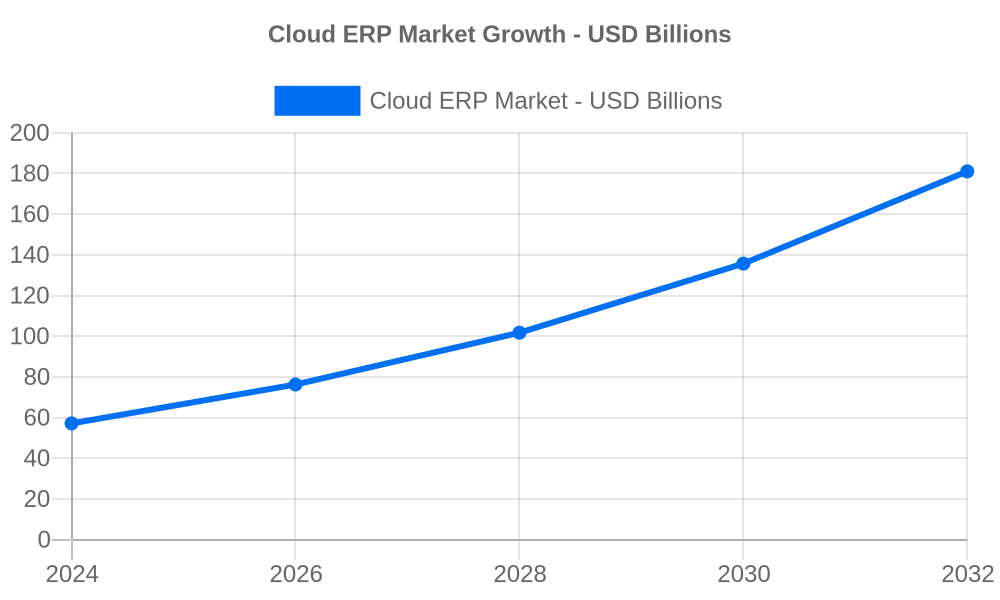
The market signal is unambiguous. Per DocuClipper's 2025 ERP statistics report, 70.4% of ERP deployments were cloud-based in 2024, up from 69.8% in 2023, and the global cloud ERP market is projected to grow from $57.17B (2024) to $181.04B (2032) at 15.5% CAGR. For manufacturers still on QAD SE or EE, investment, OEM tooling, and partner-ecosystem energy is flowing to cloud; laggards fund work that will need to be redone.
QAD's roadmap is now cloud-first. In November 2025, QAD launched the Adaptive ERP evolution with Agentic Champion AI, designed to "accelerate time to value with rapid deployment and measurable ROI in weeks, not months" per BusinessWire, 2025-11-13. The intelligence layer sits on the QAD Adaptive ERP cloud platform; for QAD SE or older EE, the gap to cloud capability widens each release.
For automotive suppliers, OEM compliance adds a second pressure. The MMOG/LE (Materials Management Operational Guidelines / Logistics Evaluation) standard from AIAG and Odette is the global automotive supply-chain assessment framework. QAD includes mapping of 176 MMOG/LE criteria across six assessment domains (Strategy & Improvement, Work Organisation, Customer Interface, Production Planning, Product Control, Supplier Interface) embedded in the automotive ERP edition.
The greenfield-versus-brownfield decision is worth naming. Manufacturers spinning up a new plant or EV division can go cloud-native from Day 1, as Digitus's greenfield QAD AERP 2023 implementation for an EV component manufacturer illustrates. Brownfield migrations are the focus of this guide. They carry a distinct risk profile anchored in continuity, compliance preservation, and methodology applied to data and EDI handover.
What business outcomes should you expect from a QAD cloud migration?
Outcomes vary by starting state, but four categories are credibly supported by the published evidence base.
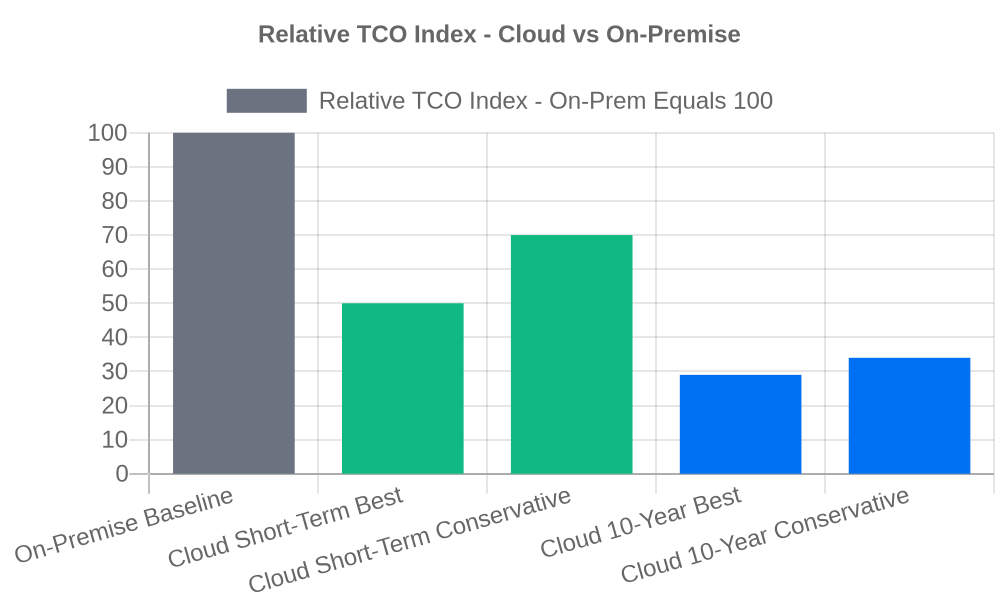
Cost-structure outcomes lead. Cloud converts CAPEX (server refresh, license purchase, DBA staffing, DR infrastructure) into an OPEX subscription with vendor-managed redundancy. Bizowie's 10-year TCO comparison finds cloud ERP costs 30% to 50% less in shorter-term comparisons and 66% to 71% less over 10 years across all business sizes. The 10-year horizon is where on-premise upgrade projects, hardware refresh cycles, and accumulated maintenance fees compound most heavily.
Deployment-speed and reliability outcomes follow. JENRS academic analysis reports cloud deployments happen in weeks, "compared to installing and configuring On-Premise based QAD, which takes several months… midsized manufacturers deployed QAD in 12 months or more." Cloud QAD targets a 99.9% uptime SLA with geo-redundant backups, hard to match on-premise without significant hot-standby investment that is often left out of on-prem TCO baselines.
Compliance and feature-velocity outcomes complete the picture. A well-designed, MMOG/LE-aligned automotive core model improves supplier-rating, inventory, and training outcomes. These gains follow from the core-model design, not from cloud-vs-on-premise per se. What cloud unlocks is the ability to keep that core model current as QAD evolves it, without manufacturer-side upgrade projects.
What does a real multi-BU QAD cloud migration look like in automotive?
One publicly documented multi-BU QAD cloud engagement in the partner ecosystem is Digitus's work for a global automotive ancillary manufacturer with on-premises installations of QAD SE and QAD EE in multiple business units across the globe. The full narrative is published as our QAD ERP upgrade case study; we summarize outcomes here as evidence for how a planned brownfield migration plays out.
The starting state captures what makes automotive QAD migrations hard. Six BUs (four on QAD EE and two on QAD SE) ran with different versions and historical customizations, no global process standardization, an active EDI trading-partner network handling demand call-offs and shipment notifications, and a tailor-made barcode-based Material and Logistics application. The concerns articulated up front were the ones we hear most often: fear of OEM re-certification triggers, fear of EDI disruption during cutover, and skepticism that a multi-BU global process model could coexist with continent-specific local compliance.
We executed in two phases. Phase 1 was a big-bang go-live for the four QAD EE BUs onto QAD AERP 2022 on Cloud (legacy logistics uplift, technical data conversion, global core model design, and EDI trading-partner migration) delivered in what the case study describes as "a record-breaking time of eight months." Phase 2 took a focussed approach there after for the two QAD SE BUs, new to the global core model and to QAD's Enterprise Finance module.
Three outcome themes are the headline evidence. First, refinements followed the guiding principles of business functions for automotive suppliers during the core model design, making the customer directly compliant for certifications and compliance. Second, EDI trading-partner migration was handled with what the case study describes as a meticulous approach to migrate the trading partners; all active demand call-offs and shipment notifications were migrated to the new QAD AERP 2022 environment in lines with the overall project goals. Third, the implementation achieved standardization of business processes across continents and countries with strong local compliance, addressed through minor tweaks to the global core model for site-specific requirements.
How do you evaluate whether you are ready for a QAD cloud migration?
A readiness assessment surfaces the questions a CFO will ask before sign-off. Five dimensions deserve scoring before committing to a program, and each maps to a workstream Digitus's QAD ERP implementation and migration services practice covers.
Data quality. How clean is your master data (items, customers, suppliers, BOMs, routings, work centers, GL accounts)? How much transactional history needs to migrate? For QAD EE to QAD AERP, technical conversion of historical transactional data and opening balances is feasible. For QAD SE to AERP, the path typically involves exports/imports and opening-balance transfer. The data scope decision affects timeline, cost, and post-go-live reconciliation.
Customization inventory. How many bolt-ons, custom programs, modified screens, and add-on integrations live on top of your current QAD? Heavy customization is not a blocker, but every customization that survives becomes a maintenance liability against future QAD updates. The right question: which customizations encode genuine competitive advantage, and which were workarounds for gaps in the version you happened to be on? The latter are candidates for retirement against current QAD AERP capability.
EDI and integration surface. How many EDI trading partners are active? Which transaction sets are in use (demand call-offs, shipment notifications, ASNs, invoices)? Which middleware sits between QAD and the trading-partner network? Cloud cutover requires re-onboarding for each active partner. For multi-system scenarios (QAD plus Oracle EBS, QAD plus PLM, QAD plus WMS), our work on QAD and Boomi integration for manufacturing shows how a Boomi iPaaS layer can decouple QAD from its trading-partner network during cutover.
Multi-BU scope and process variance. Are all BUs running comparable QAD versions and configurations, or is the estate heterogeneous (as in the case study)? Is there an existing global core process model? Heterogeneity shapes the sequencing decision.
Compliance and audit-trail preservation. For automotive manufacturers, this is where MMOG/LE, IATF 16949, and OEM-specific quality requirements intersect with the migration plan. Compliance-aligned core model design, the approach used in the case study, minimizes the customization required to meet automotive standards by aligning the new QAD AERP environment with established automotive process maps from the start.
How should you think about cutover sequencing and EDI continuity?
Cutover sequencing is where business cases either survive board review or die in IT-steering committees. The evaluative question is not "what sequence should I use?" (tactical detail belongs in the procedural companion guide), it is "what trade-offs am I making with each approach, and which am I willing to accept?"
The two ends are big-bang and fully phased. Big-bang takes all in-scope BUs live in one window, maximizing post-go-live simplicity but concentrating risk into one cutover. Fully phased takes BUs live one at a time, minimizing per-BU risk but maximizing parallel-operation cost.
In practice, multi-BU automotive estates rarely choose either extreme. The Digitus case study used big-bang for the four QAD EE BUs (homogeneous starting state) and applied a focussed approach there after to the two QAD SE BUs. Evaluation criteria: BU homogeneity, supply-chain interdependency (BUs sharing OEM customers may need to migrate together), OEM visibility requirements, the automotive production calendar (model changeovers and plant shutdowns are natural cutover windows), and change-management capacity.
EDI continuity is the second non-negotiable workstream alongside compliance-aligned core model design. For a Tier-1 or Tier-2 supplier, EDI is the spine of daily operations: demand call-offs trigger production, shipment notifications close the loop, and any break translates to missed JIT windows, OEM chargebacks, and supplier-scorecard damage.
Three architectural patterns reduce EDI risk. Direct re-onboarding: each partner's connection is reconfigured to the new QAD AERP cloud environment with a tested per-partner sequence (the pattern the case study used, which works when the partner network is moderate and partner-side teams are responsive). Middleware decoupling: an iPaaS platform like Boomi sits between QAD and trading partners, so when QAD moves to cloud, only the middleware endpoint changes while partner-side configuration stays stable. Hybrid: middleware for higher-volume partners, direct re-onboarding for the long tail. Whichever pattern, the EDI workstream owns a complete trading-partner inventory, a tested dry-run validation suite, and a per-partner rollback protocol.
For the step-by-step execution playbook (data migration tactics, cutover sequencing checklists, and EDI coordination protocols) see our companion guide on executing a QAD cloud migration.
What is the real TCO picture for a mid-sized automotive manufacturer?
The TCO conversation is where automotive cloud migration business cases are most often weakened, because the on-premise baseline is calculated incompletely, or the cloud comparison is framed at the wrong scope. Building a credible TCO model requires inventorying every cost category on both sides at the same granularity.
The on-premise stack is broader than most CFO templates capture. Per JENRS academic analysis of mid-sized manufacturers, annual maintenance fees on QAD on-premise installations run 15% to 20% of original license cost, compounding year over year (a single academic source, so treat as illustrative). An honest TCO must also include DBA and IT staffing; hardware refresh every 3 to 5 years; infrastructure depreciation; DR infrastructure and testing; power, cooling, and data-center overhead; security tooling; upgrade project labor and parallel-environment costs at every major version; and IT-opportunity cost.
TerraZone's TCO breakdown gives infrastructure-only numbers for a mid-sized workload: hardware depreciation $28,000/year, maintenance contracts $16,800/year, IT staffing $30,000/year (0.5 FTE), and power and cooling $7,379/year, for a stable annual on-prem cost of roughly $82,179. This excludes license maintenance, DBA labor beyond 0.5 FTE, and DR infrastructure. TerraZone notes that for raw compute and storage at full utilization, cloud can cost more than on-premise, but that comparison excludes the full ERP cost stack.
The crucial framing: infrastructure-only comparisons are not full ERP TCO comparisons. Once license maintenance, DBA headcount, upgrade project costs, hardware refresh, DR, and parallel-environment costs of multi-year upgrades are added, the comparison inverts decisively in cloud's favor. Bizowie's 10-year analysis finds cloud costs 30% to 50% less short-term and 66% to 71% less over 10 years.
The cloud cost stack: subscription licensing (per-user or per-transaction); data storage and egress; integration and middleware; support tier; training; and one-time migration and implementation (often the largest year-one line item). Cloud reduces long-tail costs while concentrating spend in subscription and implementation. The honest business case assigns ranges to both sides, not point estimates.
A measurable post-migration validation framework is what separates a successful migration from a successful-looking one. Three timeframes anchor the cadence.
30-day stabilization (operational). Is the platform delivering 99.9% uptime? Are daily batch processes completing on time? Are EDI transactions flowing without error rate increases? Are user-reported issues trending downward? Are month-end financial processes operating without intervention? Operational KPIs: uptime percentage, batch completion time, EDI transaction success rate, EDI processing latency, user issue volume trend, month-end close cycle time.
90-day TCO check (financial). Are infrastructure costs tracking to plan? Are subscription costs aligning with forecasted user count and transaction volume? Are integration and middleware costs in line with the business case? Are IT-staffing redirections (from on-prem DBA to higher-value initiatives) progressing? Financial KPIs: monthly infrastructure spend, OpEx-vs-CAPEX shift, subscription cost per user, integration runtime costs, IT-staff capacity reallocation. This is where the CFO's business case gets its first real-world calibration.
12-month strategic review (impact). Are OEM scorecard metrics improving (on-time delivery, quality, supplier rating)? Has MMOG/LE assessment performance moved in the expected direction? Are inventory levels trending toward MMOG/LE-aligned target ranges? Has supplier rating improved against the MMOG/LE-aligned baseline? Are users adopting Adaptive UI, analytics dashboards, and mobile workflows? Is IT spending its freed-up capacity on business-value initiatives?
The Tier-1 automotive supplier case profiled in QAD's November 2025 Cloud Transformation article describes the go-live outcome for that specific Arista engagement as a "smooth go-live with no business disruption." That single-engagement outcome, combined with the multi-BU brownfield evidence from the Digitus case study, illustrates what well-scoped and well-executed QAD cloud migrations can deliver under appropriate methodology and risk-mitigation discipline.
How does Digitus approach QAD cloud ERP migration for automotive manufacturers?
Our QAD Adaptive ERP practice is anchored in two principles: methodology over heroics, and OOTB core model alignment over manufacturer-specific customization. Both were tested at scale in the six-BU case study and the EV component manufacturer greenfield engagement.
For brownfield migrations like the QAD ERP upgrade case study, our methodology covers eight workstreams: legacy logistics solution uplift, technical data uplift, global core model finalization with minor tweaks to the global core model for site-specific requirements, key user training and conference room pilots, business acceptance confirmations, big-bang go-live for the homogeneous BU cluster, a focussed approach there after for the heterogeneous BUs, and a meticulous approach to migrate the trading partners. This is the methodology that delivered the four-BU initial phase in a record-breaking time of eight months.
For automotive-specific design, we follow QAD OOTB Automotive Supplier process maps as the design baseline, aligning the new QAD AERP environment with established automotive process flows from Day 1. In the case study, refinements followed the guiding principles of business functions for automotive suppliers, making the customer directly compliant for certifications and compliance. Our integration practice extends beyond QAD-native flows: Boomi iPaaS for master-data sync to systems like Oracle EBS, EDI middleware for trading-partner continuity, and Liferay DXP for supplier and customer experience layers.
What differentiates our cloud migration practice is the combination of multi-BU phased delivery experience, automotive-specific core model expertise that maps to MMOG/LE-aligned process design, and an EDI continuity methodology demonstrated by the case study's meticulous approach to migrate the trading partners across the active demand call-offs and shipment notifications.
Ready to build the business case for your QAD cloud migration?
We help automotive Tier-1 and Tier-2 manufacturers evaluate QAD SE/EE-to-cloud migration through full TCO assessment, OEM compliance alignment, EDI continuity planning, and multi-BU sequencing strategy. Read our QAD cloud migration case study for the detailed six-BU global engagement, or explore Digitus QAD ERP services for the full practice scope.
Journal of Engineering Research and Sciences (2025). "Cloud ERP vs. On-Premise QAD ERP: A Cost-Benefit Analysis for Mid-Sized Manufacturers." https://www.jenrs.com/v04/i07/p001/
What are the main outcomes automotive manufacturers see from a QAD cloud ERP migration?
Manufacturers migrating from on-premise QAD SE or EE to QAD Adaptive ERP cloud typically see four outcome categories: cost-structure shift (30% to 50% lower TCO short-term and 66% to 71% lower over 10 years per Bizowie, 2025), deployment-speed gains (weeks for cloud vs months to 12+ for on-premise per JENRS, 2025), reliability improvements (99.9% uptime SLA), and compliance gains aligned with MMOG/LE process standardization. The Digitus six-BU case study delivered the initial four-BU phase in a record-breaking time of eight months, with compliance-aligned core model refinements making the customer directly compliant for certifications and compliance.
How much does on-premise QAD really cost versus cloud QAD?
A complete on-premise TCO must include license maintenance fees (15% to 20% of original license cost annually per JENRS analysis of mid-sized manufacturers), DBA and IT staffing, hardware refresh every 3 to 5 years, infrastructure depreciation (~$82,179/year for a mid-sized workload per TerraZone), disaster recovery, and upgrade project costs. When all categories are captured, Bizowie finds cloud ERP costs 30% to 50% less short-term and 66% to 71% less over 10 years. Infrastructure-only comparisons that exclude license maintenance and upgrade labor can mislead board conversations.
How long does it take to migrate from QAD EE on-premise to QAD AERP cloud?
Industry-benchmark cloud ERP deployments happen in weeks rather than the several-months-to-12+-months range typical for on-premise QAD per JENRS. For multi-BU automotive migrations specifically, the Digitus case study delivered four QAD EE BUs to QAD AERP 2022 on Cloud in what the case study describes as "a record-breaking time of eight months." QAD's November 2025 launch of Adaptive ERP with Champion AI introduces additional automation aimed at rapid deployment with "measurable ROI in weeks, not months" per BusinessWire, 2025-11-13.
What is the risk of EDI disruption during a QAD cloud migration?
EDI disruption risk is the single most common concern automotive manufacturers cite when delaying cloud migration, and it is mitigable. The Digitus six-BU global case study migrated all active EDI demand call-offs and shipment notifications to the new QAD AERP 2022 cloud environment with a meticulous approach to migrate the trading partners in lines with the overall project goals. Three architectural patterns reduce EDI risk: direct re-onboarding with tested per-partner cutover windows, middleware decoupling via iPaaS platforms like Boomi, and hybrid patterns. EDI continuity should be treated as a first-class workstream from project initiation.
Will we need OEM customer re-certifications after a QAD cloud migration?
Re-certification risk depends on the methodology used. In the Digitus case study, compliance-aligned core model refinements followed the guiding principles of business functions for automotive suppliers, which made the customer directly compliant for certifications and compliance. The mechanism: the new QAD AERP environment is designed from Day 1 to align with established automotive process maps, rather than treating compliance as a post-migration remediation effort. Manufacturers using heavy customization or non-OOTB-aligned designs may face different re-certification scope.
How does MMOG/LE compliance factor into the cloud migration decision?
MMOG/LE is the global automotive supply-chain assessment standard from AIAG and Odette, covering six domains across Strategy & Improvement, Work Organisation, Customer Interface, Production Planning, Product Control, and Supplier Interface. QAD includes mapping of all 176 MMOG/LE criteria within its automotive ERP edition. MMOG/LE-aligned implementations deliver measurable supplier-rating, inventory, and training-effort improvements, and those gains compound when delivered through a current cloud QAD AERP environment receiving ongoing standards-alignment updates.
How does multi-BU sequencing change when business units span multiple continents?
Multi-continent BUs add three complications: local compliance variance per country, timezone-driven cutover window constraints, and change-management variance across user populations. The Digitus six-BU case study handled this by designing a global core process model with site-specific local compliance addressed through minor tweaks to the global core model. The sequencing used big-bang for the four QAD EE BUs (homogeneous starting state) and applied a focussed approach there after to the two QAD SE BUs (heterogeneous starting state, additional Enterprise Finance onboarding). The pattern generalizes: cluster homogeneous, low-interdependency, high-capacity BUs into big-bang, and sequence the rest.